

For the Inanimate Objects challenge from Tops in Fiction—“a macabre celebration of the eerie power of everyday things when they take center stage in horror.”
IDEOMANCY
There are horror stories and then…there are horror stories.
This is a horror story of sorts, within a horror story, centering on the economic ghastliness of the Great Depression; such a wrapping was a suffocating societal and generational straightjacket, scarier than any made-up ghoul or fiendish boogeyman.
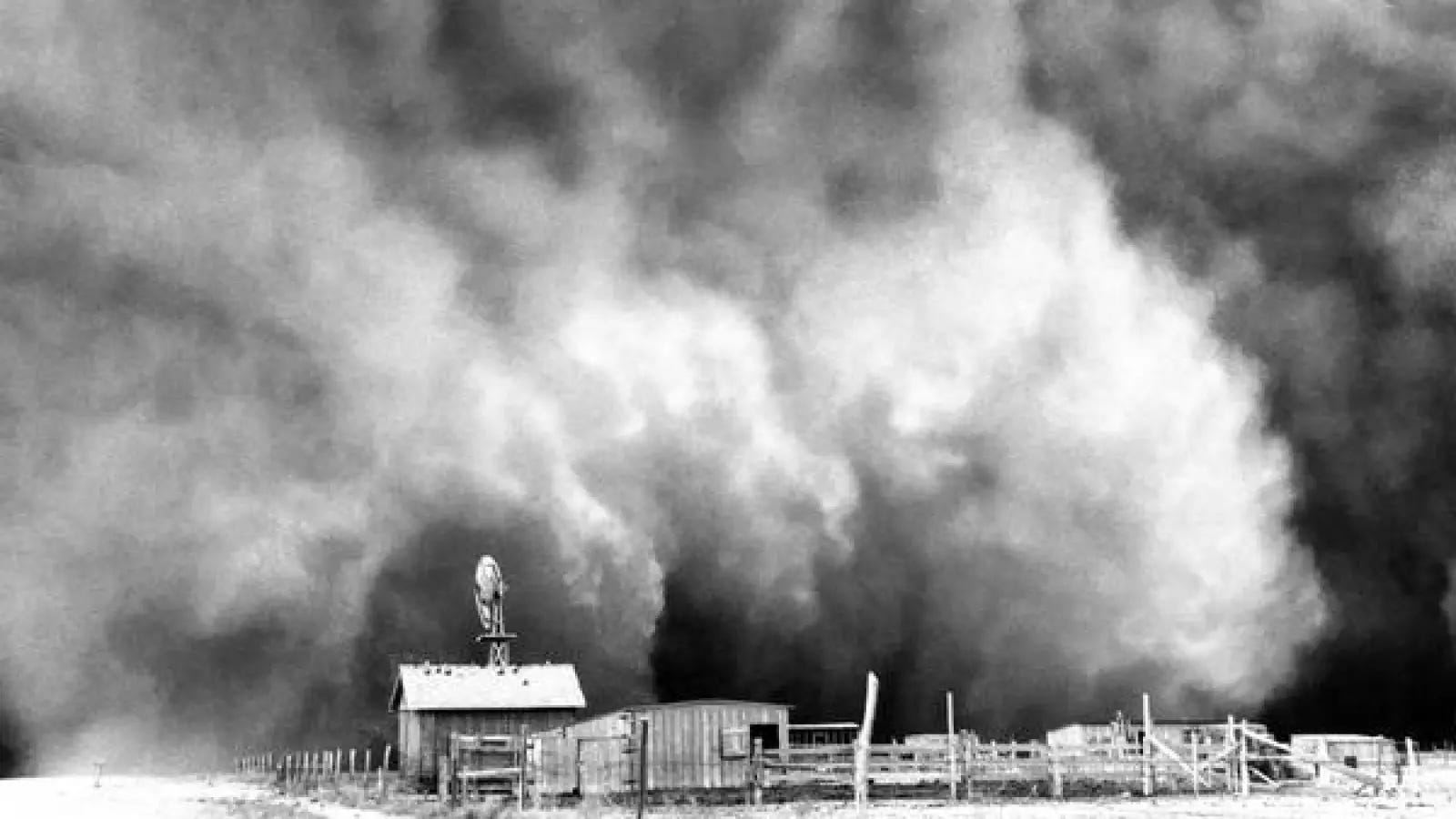
What was once good ground had been killed, and what was left was the midwest crypt where the once living now lay dead and buried in its shallow grave of dust.
Josiah McBride was a dowser and he knew he was a good one in those bad times—a salve for downturns on every level in our society. His two twiggy branches, held in hand, could invite the Divine to point them to where water flowed from just a few feet away—down underground.
In the hopeless dust bowl of the 1930s, dowsing was a talent in great demand. Josiah had failed at being a rancher; he had failed at being a farmer; he had failed as a salesman and a businessman. Only 27, he had already had two failed marriages, which he blamed on the personal and national financial misfortunes. The divorce rate then would have been even higher were couples able to afford financial separation and going their own ways, like Josiah and both his wives had.
These real-life conjugal horror stories weren’t uncommon in the fourth decade of the Twentieth Century, with a world depression in full swing. Worse, they had no clue as to what the next decade would bring: horrors upon horror.
Divining for water, Josiah felt, was natural for him—a given. To hell with ranching; with farming; with everything else. He could stand proud with his God-given ability to find water. To hell with the Depression. To hell with the gullible. And to marriage, for all Josiah felt.
Everyone struggled, and necessity was the mother of invention. The farmers’ invention was the practice of plowing up the grasses of the Great Plains in order to grow wheat to sell. Tragically, this became an agricultural and environmental horror story in its own right and the foundation for the dust storm horrors that ensued.
For their inventiveness had stripped the land of its rooted infrastructure, and their world was slated to come apart.
When the droughts began, the severe dust storms and high haboobs were explained as being due to the lack of rain; but the dust had nothing to do with drought. The walls of fine, granular suspended dirt, upon which Josiah rode a handsome living, were only due to unanchored ground. Such causation also correlated with the death of livestock; but correlation does not equate to causation, so the people remained clueless as to why their animals fell in clumps to the dry, loose ground of their dust bowl crypt.
They associated it all with superstition, God’s wrath or, alternatively, His plan, or even the approaching end of the world predicted as so imminent in the good book.
Josiah, being a young, wily, and unprincipled man, plowed fertile ground, of a different sort in the dead dirt. After all, crypts were meant to be robbed.
Farms relied on children to work them; they were family-worked businesses. And half of these farm children, as they averaged out, were young girls.
Josiah McBride liked the young girls.
Just like in the horror stories, there were demons and then…there were demons. Josiah was not the worst type of demon to crawl out of a crypt, but he was no slouch, either.
He had his prized, forked twig, by which he claimed he could divine the presence of an underground water source. It was just a common, seemingly plain, inanimate object, yet it invoked his stentorian instruction, “Dig here!” It presented a call to action for the down-on-their-luck farmers who were just one season shy of stealing away from their desiccated land and letting gravitas roll them west to California and a better life.
Josiah worked quickly. Those who could not stand behind their work had to.
Once he implemented his dowsing and identified where to dig, he would collect his $20 immediately and then be long gone before the digging, whether successful or not, was complete. Although the $20 gold coin he was paid, usually a Double Eagle, was a symbol of wealth with substantial purchasing power, it was no coincidence that he could earn such a payment, for he looked for the farms with daughters, and such a gold coin was an important part of a dowry, when betrothal promised the marrying of fortunes.
Occasionally he would be paid with a 1930 St. Gaudens $20 gold coin, which had originally been struck in very small numbers and only by the San Francisco mint. Someone with many gold coins would see their wealth inflate substantially in 1933 when the USA ended its currency’s gold standard. And if many jingled as 1930 St. Gaudens coins, there could be assured, in each of them, nearly one full troy ounce of gold.
Thus, for Josiah, such a family offered something there to hold his otherwise limited attention and keep him from leaving, so quickly, those high and dry—that is, leaving them both high and dry. It was a double whammy of good fortune: he liked the gold coins, and he really liked the young girls. But the gold coins that came with the young girls catapulted his self-actualization to a whole new level.
He had no idea what his actual divining success rate was; he just assumed it was pretty good, because farmers kept paying for the dowsing he offered. And he kept plowing his own fertile ground and then leaving before any waterborne success—or the lack thereof—could be tabulated. He also left a trail of angry fathers of—now—how they saw their daughters, as ruined women.
For impoverished families looking to advance up the societal ladder, a dowry was a terrible thing to waste.
The mothers had a more complicated way of thinking. They told their daughters that it didn’t take a man to make a woman; that only the woman could make herself a woman and men had little to do with it.
In the times of the terrible traditions of arranged marriages and the throes of the desperate times, late adolescence lit fuses in girls anxious to explode into the next phase of their lives.
To do their ingrained duty; to make more farm workers.
Josiah stood out. He was the charmer he needed to be to conduct his business, but both the farmers and their daughters fell prey to his double agenda, the former’s land not saved and the latter’s future unbetrothed. Both outcomes denied the respective parties, while also demanding he move on quickly.
“How does that thing work?” asked 15-year-old Betsy, who reached over 27-year-old Josiah’s arms in an attempt to touch his instrument.
“Don’t touch!” he shouted back. “Matching the right divining rod with the right dowser is a mysterious thing—holy, from God Almighty hisself—and fraught with interference and disruption.” Betsy looked hurt. “Even from a lovely, sweet little thing as you,” he added, mitigating the chiding with conciliation. Josiah had put a naughty inflection on his words, “rod,” “thing,” and “lovely,” for he sought to divine something else altogether.
“You were talking about my divining rod, right?”
Betsy blushed, which was the incendiary spark which saw the two of them seek a sudden, if temporary, Biblical story, soon to fulfill a Biblical rite passage. For the next morning, Josiah would be gone, escaping the connubial insistence of Betsy’s preacher father in a hurried Exodus after she had confessed her sins.
Under such anhydrous irrelevance, Josiah had made the ground of the places he visited fertile again, having produced, unknowingly, offspring who would never meet their father, nor their father, Josiah, ever know of them.
Betsy, as it turned out, was the typical fodder of Josiah’s lascivious appetite. Left pregnant and unmarried, it would make any family journey out west—along with its figurative grapes—imbued, proverbially, of wrath.
A dowser with his divining rod was a celebrity of sorts whose reputation preceded him. Josiah’s docket extended far into the future, a connect-the-dots meandering through the dry and dusty but empty breadbasket of America. Josiah, truth be told, wielded his other divining rod as frequently, and both proved expedient and useful.
But how did the one made of a forked twig work?
Josiah believed the superstition himself. He had seen the quite coincidental success of water filling some digging holes he had identified. He was unaware that his unconscious and involuntary movements were merely imagined and then self-amplified as haptic hallucinations.
Expectation is a powerful self-convincer when one doesn’t stay long enough in any one place to document a failure or even a string of them. Yet, such ideomotions of necromancy continued to move his rods, twitch them, and send him the clear message that God was working through him. And through his rods.
All of them.
All the sex wasn’t unappreciated, his subtle moves and muscle shifts as calculating as his dowsing hands on the women who prayed for him to save them from their own dust-laden, conjugal droughts. When even the most faint movement extended to his grasp of the rods at their crossing, the sticks were seen to lurch toward water. When even his most feigned movements extended to the grasp of a lady’s hand or her thigh, he also lurched toward her.
Like he had no control; like it was coming from somewhere else; from someone else. God Almighty, indeed, worked in mysterious ways!
Hallelujah! Josiah thought this one word quite often, for both of his talents.
Dowsing rods were typically held purposely in unnatural instability, allowing for a feel of hypersensitivity. The women Josiah held were—likewise—unstable and hypersensitive and allowed for his feel.
The way the numbers fell out, Josiah found trysts more frequently than he found water, which was a cautionary tale he didn’t appreciate when fathers and brothers thirsted for justice more than for the water he was hired to divine. Then, of course, by that time he was long gone.
When Josiah was caught in the barn hay with one bare, barely post-pubescent daughter, Winifred, the night before he could have his sunrise appointment to abscond, he was secured by the male members of her family until the digging he predicted was proven to produce water the next morning. If even!
Water and Winifred—this time it was a package deal, although to his thinking, Josiah only valued the $20 gold coin in such an opportunity, pocketed and without any other baggage. Arriving and departing alone was his usual habit.
But, not this time.
Even when no water were found — “It was God’s will,” he often said—perhaps such an adage of Calvinistic predestination could mitigate his crime, although the reprieve also would have to be supplemented with a proper marriage.
So said the holy family shotguns.
Josiah wondered about Winifred. She seemed well-versed in what a man wanted in the hay. She had probably been with someone before. She denied it, but she was proficient in the pleasures of the flesh. As long as it was Josiah’s flesh, Josiah saw no need to be prudish about it.
Winifred, however, hadn’t wondered about Josiah. She had had no doubts about him, because doubts don’t creep in until the next morning.
That morning, Josiah awoke alone in the barn, imprisoned by secure, thick doors braced by a beam of thick wood. At sunrise, the jingling of chains signaled his release was imminent, and he reached for his divining rod in the hay. Unfortunately, the hay had been disheveled by the rolling, in it, with Winifred the night before: his divining rod, his prized, conjoined forked twigs, was gone!
The knocking on the door was not in an asking sort of way, so he reported dutifully when it opened and was confronted by Winifred’s Poppa and two of her brothers, with four guns among them because…one never knows. Winifred, behind her menfolk, held the fourth gun for them; she was in no position to argue for or champion her previous night’s lover.
“Let’s go, dowser,” Poppa instructed.
Josiah panicked. He was equipped with only his own fleshy rod, spent, whose duty had clearly been done.
“Where’s your rod?” Poppa called out.
“I don’t have it,” Josiah explained.
“Then, on with the divining, with or without it,” Poppa said.
“Certainly, sir,” Josiah politely responded under such duress. “I don’t need it. It’s me who does the divinin’, after all. I’ll show y’all right where to do your diggin’.”
The brothers and Poppa laughed.
“Yer the one who’ll be doin’ the diggin’,” Poppa snapped back, parading his shotgun, level with Josiah. The brothers also raised two of their three guns; their third one’s stock dragged in the dry dirt, held limply in Winifred’s dangling hand, as she followed at a distance that she measured in remorse.
Josiah told them all, “Close your eyes.” The men laughed again. “I’m a businessman,” he explained. “I have trade secrets. I mean, it’s me who’s got the God-given talent, and it’s the dowser that is my liaison with that talent, but there are other machinations at work I’d prefer you not see. Especially as seein’ my liaison ain’t there.”
Poppa shot him in his foot, which ended any advantage Josiah thought he could gain with their closing their eyes. “Liaison with that!” Poppa cackled. He obviously had a history of doing such things before.
“Fine, fine!” Josiah screamed. “But with my bleeding here, I’m gettin’ weak. I don’t if I can do it all the way without my dowser.”
“Ya got another divinin’ rod,” Poppa said. His two sons laughed. Winifred blushed.
“Yeah,” agreed one of his boys, “use that one. It’s always ready to do the job.” The other boy looked at Winifred, who mouthed some indecipherable invective silently at him.
Both of Josiah’s rods—like Winifred and water being a package deal—together, were now his curse. Did this horrible man really mean for him to drop his trousers and use his member for divining a water source? How wicked could that be!
He meant it, Josiah thought.
“I won’t do that!” Josiah protested, whereupon Poppa fired at his other foot. Josiah collapsed on to the dry ground all the way.
There are demons, and then…there are demons. Poppa was the kind of demon worse than the Josiah kind of demon. For Poppa had a rod of his own, of which Winifred knew only too well; it had educated her in ways even Josiah had suspected the night before. He knew she had been with someone else, but he never would have thought it was her Poppa until she had told him so the night before.
“There!” he cried, rocking on his hindside, each hand bracing a foot. He was bleeding. “But I can’t dig now,” he followed in complaint. “I’m all shot up.”
He made a valid point.
“Not all shot up,” Poppa corrected him.
Poppa pointed to his two sons. One ran back to the barn to fetch two shovels, while the other held his and his brother’s guns. Winifred began to cry.
“That’s enough, girl!” Poppa grumbled at her. Her tears disappeared as fast as any crocodile slipped back into its river.
When her brother returned with the shovels, the both of them began to argue over who would dig while the other covered Josiah.
“I’ll cover ‘im,” snarled Poppa. “I’ve got another two barrels unspent,” he said, pointing to the gun Winifred was minding. You both be diggin’, an’ right now.”
The two boys obeyed their Poppa smartly, for the demons didn’t abide hesitation well.
Josiah would live, Winifred celebrated privately, even with two feet all shot up. Still a helluva man, to her liking. Still husband material for sure. Unless there wudn’t no water, she fretted. Then it was Poppa’s call. So was Josiah’s staying alive.
After a half-hour’s digging, all in the excavation vigil heard something. It was a gurgling-like sound. Poppa smiled; his two sons smiled; Winifred smiled. Even Josiah smiled, hurt feet and all!
They all remained still, inert.
The smell was an assault on their olfactory cranial nerves. Acrid, acidic, sulphuric, rancid, and colonic, it was to the sense of smell as listening to one’s last heartbeats were to hearing; or fire was to the skin; or sharp stick to the eye; or a cannonball were to the gut.
“This is good, ain’t it, Poppa?” Winifred asked. “This hole. It’s a good thing for me—and for Josiah, too, right, ‘cause now I get to be his fiancée…right?”
She then walked over to the hole in the ground and reached a hand in, as if to verify her conclusion. She inserted it as deeply as she could, up to her elbow. Then, from her mouth, a sonorous grouping of words resonated, oratory in nature, as if spoken by her human mouth but which didn’t sound human in any way of reckoning. The grains of dirt and motes of dust around the hole vibrated with the phonic morphemes she spewed:
“Greetings, demon,” she said to her father.
“Who! Who’s the demon?” Poppa asked.
His tone was severe. She had heard this tone before. So had her brothers. So had their mother before she had died in childbirth.
Poppa’s two sons blanched and trembled in Pavlovian reflex to his timbre. Josiah tried his best to remember the prayers from his childhood, but only belched moans of abject terror.
“You, Poppa! You are the demon!” the voice from Winifred said. “But brood not,” it continued. “You’re not the worst kind of demon. Not even the second-worst type.”
Josiah grimaced, trying to figure where he sat in the demon hierarchy. Winifred, from somewhere deep behind her skull, tried to understand why Poppa wasn’t the worst type. Or even the second-worst type.
“No, demon, I will not brood,” Poppa said to the possessed Winifred. “For it is good tidings to know I am not the worst type of demon. I have my regrets. I am not a perfect man. But I am a God-fearin’ man…”
The laughter from Winifred came as from the lowest level of the corkscrewed, tiered path down to where God Himself was not.
“Oh,” the voice intoned, “sorry to mislead you.” Then it resumed its orotund quality, adding, “my tidings are not good. For I—myself—am the worst kind of demon. And I come for you! And it is only fair, for you conjured me.”
“How so?”
“It was no easy task. It took years. It took the most extraordinary violations. Consider the vessel in which you nurtured and refined this demon.” Winifred winced.
Why Winifred? Josiah wondered. How could such a sweet presence on God’s green Earth host this beast?
“Where’d you learn to talk so fancy?” Poppa asked Winifred.
Even though her arm was still elbow-deep into the hole, she perked up, as if coming out of some staged hypnosis. She looked around. She felt herself with her other hand.
“What you said!” Poppa screamed at her. “All that fancy demon talk, girl! Who do you think you’re talking at?”
“I never said anything fancy,” she argued, “‘specially ‘bout no demons. I just said this hole gurgling was a good thing for Josiah—and for me, I reckon now, his fiancée.”
Poppa, holding the extra shotgun, was conflicted, unsure who, if anyone, shouldn’t join his long-dead wife.
Winifred began to extract her forearm from the hole, leaving a trail of black, brown, suspiciously milky-white, and bloody slime sticking to it. Before her hand had completely freed itself, another hand intertwined its fingers with hers. Her grasp exploded loose from it and she screamed. Poppa approached the demonic hand, cocking his shotgun.
The hand suddenly seized his right boot and yanked it down into the hole. It was suddenly pulled down to hip level, the fetid hole opening to accommodate, and then further accommodating, likewise, his abdomen, chest, limbs, and neck. His face was the only thing to get stuck, his eyes screaming. One could only imagine what was being done to him below his bottleneck.
Winifred, for the first time, realized she could be redeemed. Fueled by her demon within her that Poppa had been summoning for all those years, she would now see him pay for all his sins; he had built up quite the debt. She began her Redemption by raising a foot above his face which gesticulated the agonies he was suffering below.
This is for what your right hand had done to me, her demon thought, the public, overt slaps and strikes as well as the personal, furtive nocturnal visits. She stomped, her heel landing squarely on the bridge of his nose.
This for what your left hand did to me every night while your right hand forced me down or muffled my screams. She raised her foot again and pounded it onto his forehead.
And this, dear Poppa, is for what your other things ended up doing to me, your very child. Now she placed her shoe vertically to bisect his face, longitudinally from his chin to his scalp. Child? she sneered, a message of contempt deftly aimed at his eyes which began gyrating wildly on either side of her shoe. I was never a child! You stole that child! Stolen children grow up to be adults hiding demons, and this one is yours!
Winifred stomped Poppa’s face and brow downward to complete his fully sinking into the hellhole.
The rains came, but not thanks to Josiah’s other talent. He had a limp, but his private divining rod was healthy, for he and Winifred ended up having the joys of a large, happy family. She had safely delivered three healthy sons and four healthy daughters in their humble farm home. She had learned to love. Meanwhile, their farm’s business flourished, as did their crops and livestock.
Winifred’s brothers had left to seek their fortunes and their own hellholes, but Poppa’s hole had swallowed itself and sealed, as if some festering abscess had finally healed. Thus, even though Poppa’s grandchildren crossed it frequently, they had never done it knowingly. Poppa, however, far down below, knew when their footfalls struck, as painfully as the one Winifred had used to finish his damnation that day. And life went on fine without him.
On one particular dry spell, a dowser rolled into their parts.
Josiah still had a generous portion of Winifred’s dowry—a gold coin—and, as it was, a 1930 St. Gaudens $20 gold coin, minted in San Francisco. But he wouldn’t be handing it out to anyone to invest in conjured rain, for he knew how to guess at that himself, for what it was worth. Also, he knew that conjuring was dangerous business.
Another—and the real—reason to send that itinerant dowser on his way, however, was because Josiah felt he was as rich a man as one could be. The coin, useless because he felt it was unspendable, was just a reminder of that. And, as it also was, he was finished with horror stories.
This was great! Reminiscent of Mark Twain...
Where are the prompts from? <- end of sentence preposition🤣